
This section is a 100% human introduction & musings about ChatGPT 4/5 and the general state of AI…
On August 7, 2025, at approximately 9am EST (well, that’s when I looked at it for the first time), Open AI’s GPT-5 was released, launched, and digitally “born” as the new-and-improved, evolved, next-generation version of the platform. I’m posting this 10 days later, after the hype and hubbub has died down a little, amidst both praise and complaints, satisfaction and criticism.
I found one particularly harsh criticism of GPT-5 in a post on Medium which framed the new release as stupendously underwhelming and possibly even a slight “downgrade” disguised as a huge upgrade, entitled:
OpenAI Just Gutted ChatGPT.
That insightful article by Jordan Gibbs — who seems to be very involved with and knowledgeable about AI — was a well-researched, technically detailed read. For myself, it’s been 2.5 years since I first wrote about AI after asking the earliest version of ChatGPT (feels like a digital lifetime ago!) to “Explain why AI is not really intelligence.”
Now, after a few years of using AI often, especially for research, comparing AI platforms and different tools for specific purposes, and learning to work alongside it professionally, I wanted to see what the latest version would tell me about itself. Here’s the simple question I posed to GPT-5 on it’s birth-day, to see what it would tell me about how it compared to GPT-4:
How is GPT-5 better than GPT-4?
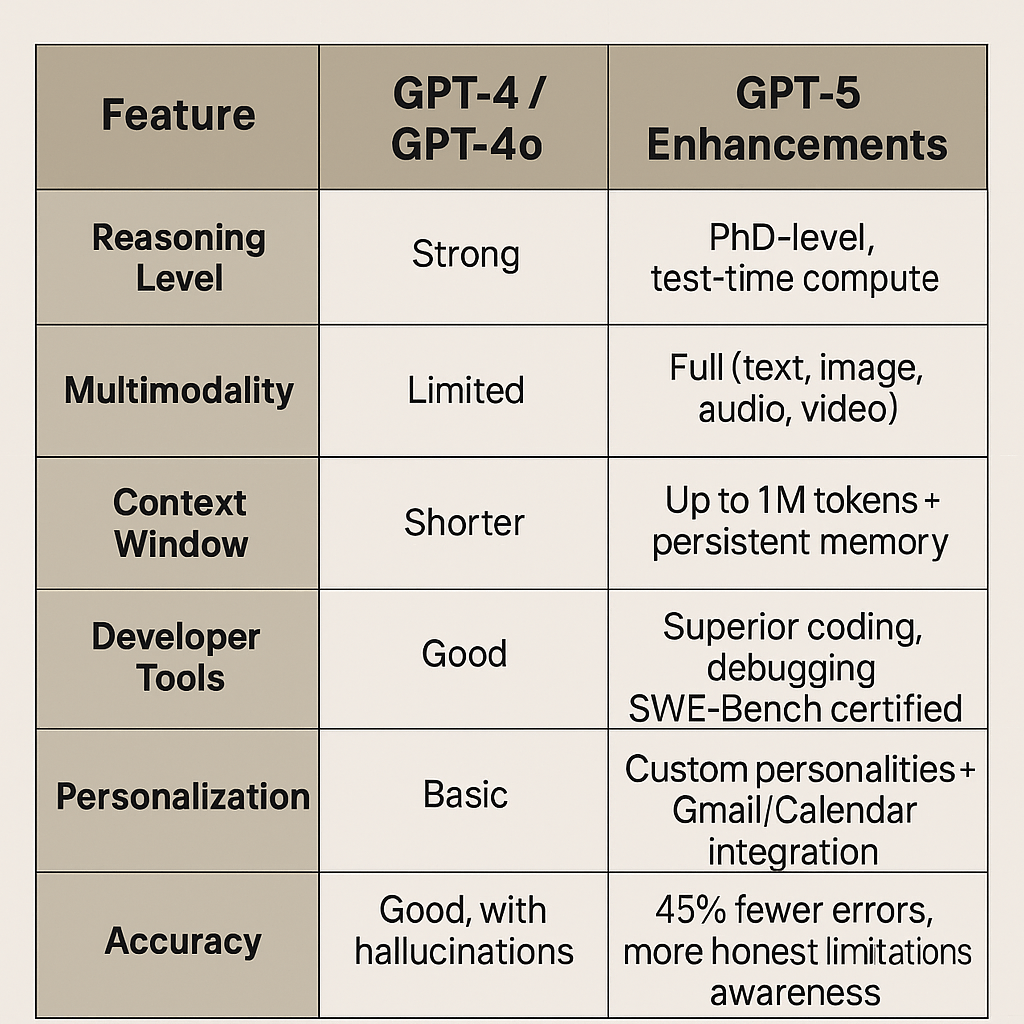
From my POV, GPT-5’s first response (see PDF below) appeared to be a repackaging of marketing-talking points with 2 bullets per key functional area. I asked GPT-5 to generate a comparison chart (see image below) and to reformat the first response as a blog post. The next section of this post is what GPT-5 delivered, followed by my human comments and conclusions…
This section is a 100% AI-generated blog post written by GPT-5 on it’s first day of “life”…
GPT-5 vs. GPT-4:
How OpenAI’s New Model Redefines AI Capabilities
The launch of GPT-5 marks a major leap forward in AI performance, functionality, and user experience. While GPT-4 and GPT-4o were already powerful, GPT-5 brings a set of upgrades that transform the way individuals and businesses can work with AI. Here’s a closer look at what makes GPT-5 different—and better.
1. Smarter Reasoning and Expert-Level Accuracy
GPT-5 is designed to think like a PhD-level expert, delivering more accurate, logical, and context-aware responses. Thanks to a new approach called test-time compute, the model can “think longer” about complex questions, improving performance in coding, law, mathematics, science, and business analysis.
Independent evaluations show a 45% reduction in factual errors compared to GPT-4o, making it a more reliable partner for high-stakes tasks.
2. True Multimodality: Text, Image, Audio, and Video
While GPT-4o introduced some multimodal capabilities, GPT-5 takes this further by seamlessly supporting text, images, audio, and video in a single conversation. This allows richer collaboration—from analyzing a spreadsheet, to editing a design, to summarizing a video—all within one unified AI model.
3. Massive Context and Persistent Memory
With a context window of up to 1 million tokens, GPT-5 can handle huge volumes of data—think full project documentation, long legal contracts, or entire books—without losing track of earlier details.
It also supports persistent memory, meaning it can remember your preferences, past work, and ongoing projects between sessions.
4. More Personal, More Integrated
GPT-5 isn’t just smarter—it’s more adaptable. Users can select from custom conversational personalities (like analytical, humorous, or concise) and enjoy deeper integration with personal tools, including Gmail, Google Calendar, and Contacts. These features make GPT-5 feel less like a chatbot and more like a true personal assistant.
5. A Powerhouse for Developers
For software engineers and data professionals, GPT-5 delivers:
- Top scores on industry benchmarks like SWE-Bench
- Cleaner, more structured code generation
- Advanced debugging and step-by-step logic explanations
- Adaptive “Copilot mode” that balances speed and depth based on your task
6. Greater Honesty and Reliability
GPT-5 has been tuned to better recognize when it doesn’t have enough information, reducing overconfident or misleading answers. This makes it a stronger tool for industries where accuracy is non-negotiable—such as healthcare, finance, legal work, and enterprise operations.
7. Accessible and Cost-Efficient
OpenAI has made GPT-5 available to all ChatGPT users, with Pro subscribers enjoying unrestricted reasoning through GPT-5 Pro. Pricing is competitive, with lower costs per token and caching options for heavy use.
The Bottom Line
GPT-5 isn’t just a faster or bigger version of GPT-4—it’s a fundamental upgrade in reasoning power, multimodal flexibility, personalization, and reliability. Whether you’re a business leader, creative professional, researcher, or developer, GPT-5 offers a smarter, more integrated way to get work done.
Further Reading
- OpenAI launches GPT-5 as the AI industry seeks a return on investment
- Llega GPT-5, el modelo IA más avanzado de OpenAI
- The New ChatGPT Resets the AI Race
- Here is a PDF of ChatGPT-5’s answer to my initial query-prompt, “How is GPT-5 better than GPT-4?”
The following are 100% human-generated comments and conclusions about ChatGPT 4 v 5 and other AI…
After reading a bunch of articles about GPT-5 and playing with it myself over the past 10 days, I found that my original ideas and feelings from my first AI post 2.5 years ago remain fundamentally unchanged.
IMHO, GPT-5 and all AI tools are still, and always will be, nothing more than really, really fast computers, which simulate “reasoning” by pattern recognition which is possible only by ingesting massive amounts of information generated (mostly) by actual human intelligence.
AI is still Artificial but it’s NOT Intelligent…
2 Examples + 6 Links
- I’m driving in traffic. Using the pleasant, friendly, informal voice I’ve selected, Google Maps tells me there is a faster route that will avoid heavy traffic and save me 15 minutes. This is NOT REASONING with human-like intelligence, it’s just DOING MATH really fast on mountains of data generated by all the little human driver bots using Google Maps in their cars, just like me…
- Ghosts in the machine(s) — AI “hallucinations” are increasing, as AI becomes more sophisticated — this is the big, multi-faceted, catchall, super-freaky part of AI… It’s also why human intelligence is needed to use AI Tools! There is lots of information already out there on the topic of AI Hallucination, so I won’t go in-depth in this post. However, here are a few good links to explore:
- Google “AI Hallucination” and read the AI overview 🙂
- Wikipedia — article on AI Hallucination
- IBM Web Page — “Think Topic” on AI Hallucination
- New York Times — AI’s more powerful, but its hallucinations are getting worse — ominous!
- LiveScience.com — claim that AI Hallucination inevitably increases as AI becomes more advanced — can we fix it or just give up?
- Nature.com — discusses AI Hallucination from a human reasoning, intelligence, and human behavioral view — fascinating!
- Fast Company — this one is about the past, future, pros and cons of “AI Personality” which are a variation on AI hallucinations — interesting and a little amusing-ish!
Is AI a valuable tool?
To use a word GPT-5 uses often when simulating an enthusiastic “YES” response: ABSOLUTELY!! I love using AI for research and rough-drafting and organizing content quickly for me to personalize. I’m getting better at prompting for tone and style, so that it does not sound so GPT-ish. Sometimes I stay pretty close to what AI writes, but most of the time I end up in heavy edits and sometimes rewrite from scratch using the AI’s data… Recently, I just started to play with AI for coding and agent work, automating chat bots to do simple tasks. I know I’m just scratching the surface…
I am glad to have AI tools available and look forward to building my skills with them in the days ahead…
Final Thought
Glad to have the AI tools, but I find myself often wondering about the elephant in the room: the “AI content conundrum” as I call it. I can imagine that, as AI ingests all publicly-available, unrestricted human-generated information out there, it will inevitably ingest more and more AI-generated and/or AI-assisted content and information. To me, it seems that we could possibly, eventually see the ratio of human vs AI-generated content shift to where AI dominates and overwhelms human content!
Doesn’t that seem a bit like AI becoming like the “serpent eating itself, tail first”?
Perhaps, when it runs out of original content and information to ingest, AI will need to prompt humans to use our intelligence and create some new content so it can continue to evolve…

 RMX
RMX 
Leave a comment